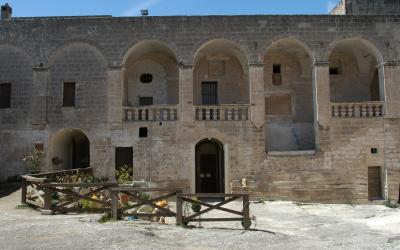
Alongside the "Ceramics Quarter," visitors can admire the art of pottery at the Ceramics Museum, housed within the evocative setting of Castello Episcopio.
This medieval edifice, commissioned in the 14th century by Archbishop Giacomo D’Atri, showcases over 500 works spanning a chronological arc from the 8th century BC to the present day. These artifacts tell the story of a past where ceramics played a vital role, serving essential needs for personal hygiene, household chores, food preservation, and the decoration of the home.
-
Opening days
Monday to Sunday
-
Opening times
August
Monday from 10:00 am to 4:00 pm
Tuesday to Sunday from 10:00 am to 10:00 pm.September
Monday from 10:00 am to 4:00 pm
Tuesday to Sunday from 10:00 am to 7:00 pm.October and November
Closed on Mondays
Tuesday to Sunday from 10:30 am to 12:30 pm and from 4:00 pm to 6:00 pm. -
Feature List
- Info line
- Wheelchair accessible
TOUR AT A GLANCE
The Museum is organized into four distinct sections: Traditional Everyday Ceramics, Archaeological Finds, Majolica, Nativity Scenes, and Contemporary Ceramics.
Traditional Everyday Ceramics
This section features ceramic artifacts used for the pantry, domestic services, and personal and home hygiene. This typology covers a period from the early 18th century to the first half of the 20th century. It is represented by a variety of traditional forms used for storing water, wine, oil, and vinegar, or for transporting supplies. Notable examples include the capasone (large storage jar), capasone alla capuana, trimmone, capasa, vummile, cicine, pitale, and cammautto.
Also on display are cooking utensils (such as the tiestu and pignata), items for washing laundry, dishes, and vegetables (crasta ti cofanu, limmu, scafarea, pendriale), plant containers (crasta, casc’pò), and sanitary ware (nicissario, rinale). The collection is completed by small jars for drawing water from wells (vucale pi puzzu a ‘ngegna), chimney pots (ciminiera), and the clay tubes used in the construction of kiln vaults (orieni).
Archaeological Section
This section displays numerous finds from the Masseria Vicentino site, located in the Grottaglie countryside. Dating between the 8th and 4th centuries BC, the collection highlights globular ollae with geometric motifs and painted or engraved paterae.
Majolica Section
Exhibits here range from the early 18th century to the first half of the 20th century. Visitors will find a wide array of plates and pitchers for water and wine (sruli), as well as the typical ciarle—vases featuring double ribbon handles. The collection also includes apothecary jars (albarelli) and tureens, whose lids are often adorned with knobs modeled after human figures, botanical elements (such as pinecones or fruit), or animals. This section also features floor tiles crafted in Grottaglie and other centers across Salento and Campania.
Nativity Scene Section (Presepi)
This collection comprises award-winning works from the annual "Nativity Scene Exhibition" (Mostra del Presepe), established in 1980. It showcases various interpretations of the ancient ceramic nativity tradition, ranging from single-block and miniature scenes to monumental displays rich with intricate characters.
Contemporary Ceramics Section
This final section preserves the prize-winning works from the "Mediterranean Ceramics Competition," held since 1971. These pieces are inspired by the themes, colors, and forms rooted in the cultures of the Mediterranean. They reflect the stylistic, technical, and formal choices of national and international artists who have shaped the trends of ceramic art over the last fifty years.
Where
Largo Maria Immacolata - 74023 Grottaglie (TA)